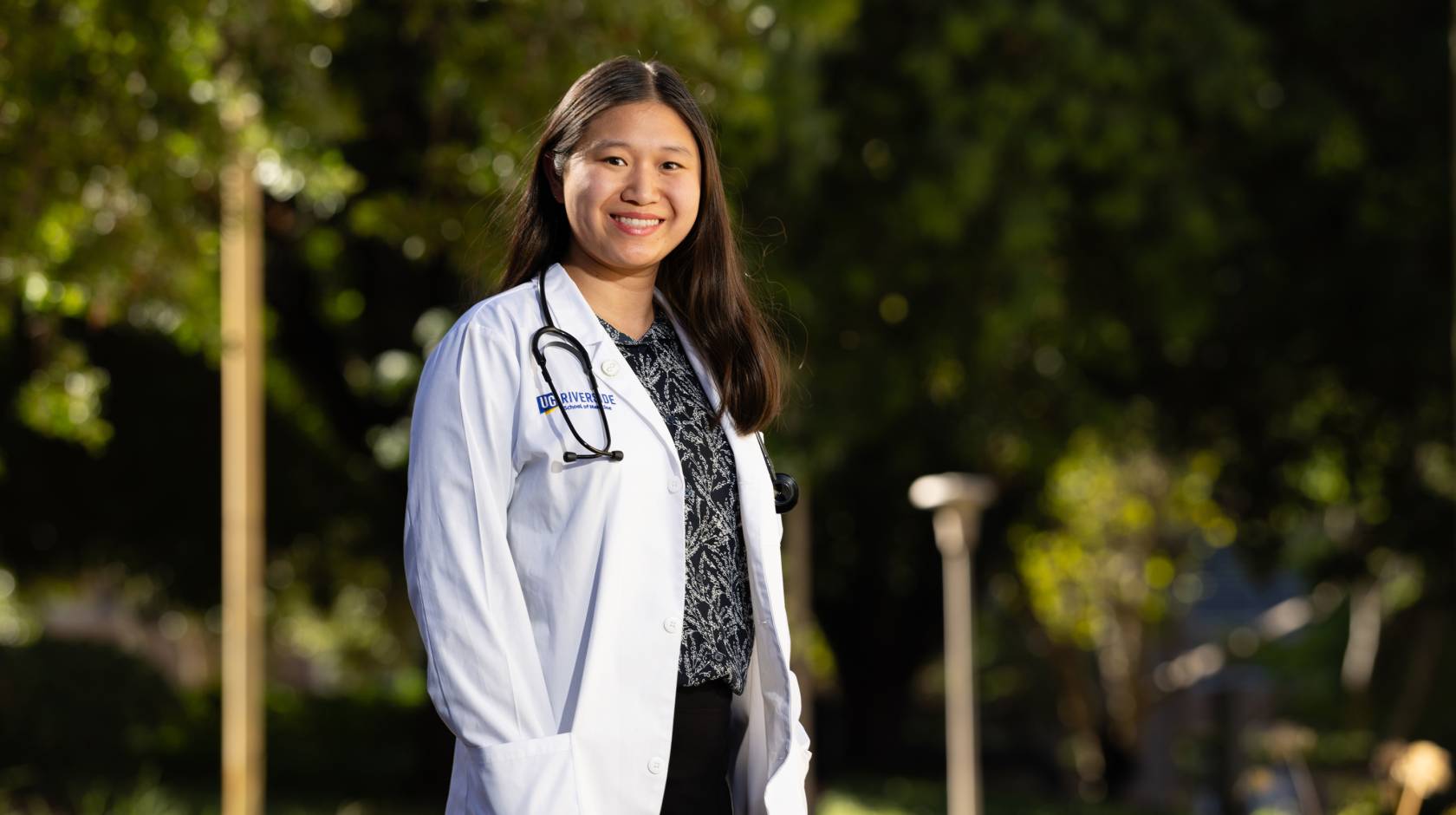
Emily Li has always been called to serve. And not just as a doctor — at 24 years old, Li already has six years of Army service under her belt.
After serving as a California Army National Guard combat medic while completing her bachelor’s degree at UC Riverside, she’s pursuing her longtime dream of becoming a doctor at the UC Riverside School of Medicine. An Army health scholarship program is paying for 100% of her medical school costs. In exchange, she’ll work as a military doctor for four years after she finishes her residency. Her goal: to serve the Inland Empire community as a primary care physician for veterans.
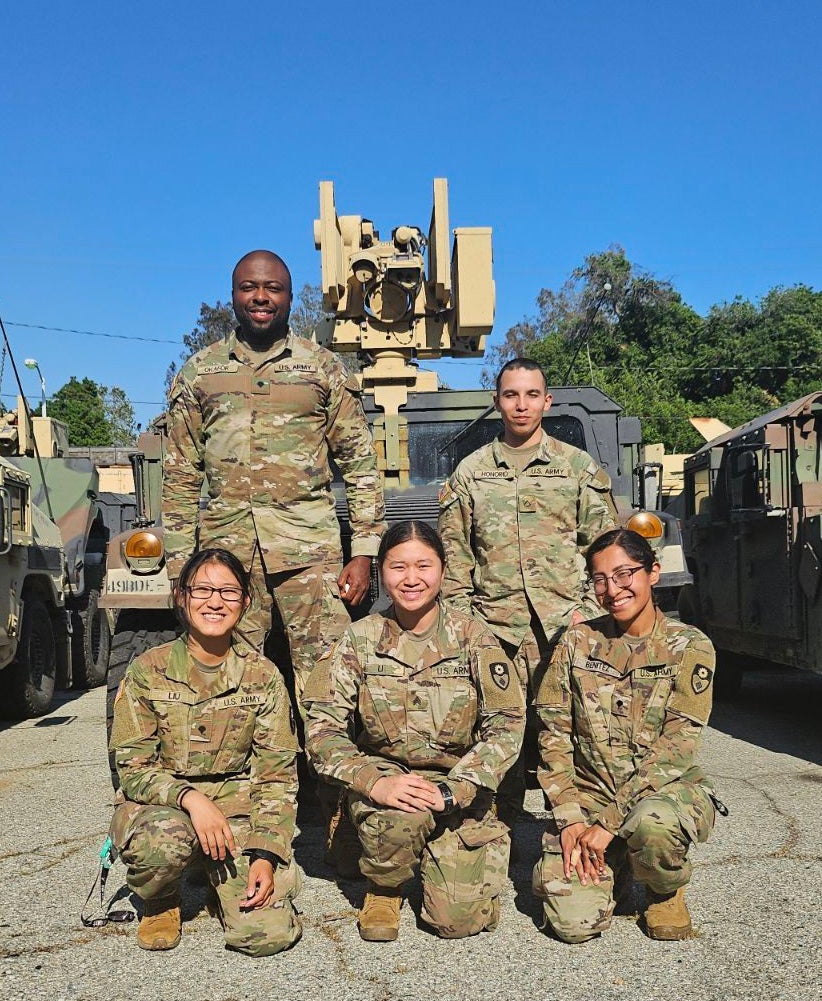
Emily Li (center) with fellow members of the California Army National Guard
UC: You’re a military veteran and a medical student — two roles defined by service and challenge. What motivates your career?
Emily Li: I was in middle school when it clicked for me that I wanted to be a doctor. My younger brother has autism, and he always needed a lot of support. So I grew up being a caregiver in the household. I have always wanted to be that doctor who understands what families are going through and can help guide them.
Being in the military, on the other hand, was never part of my plan. In high school I knew I wanted to study medicine, but I was trying to figure out how in the world I was going to pay for college. My family was low income, and I didn't want to put that financial burden on them. The California Army National Guard offered a path. I signed my contract to be a combat medic and immediately applied to UC Riverside — they were always linked together.
What advantages do you bring to medical school from your time in the military?
I did my basic training at Fort Jackson in South Carolina. At the end of your training, you have to complete a 12-mile ruck march. On a ruck march you carry a big, heavy pack — so big I think I could fit inside it. And then you have your vest, your canteens, your weapon. And you're just walking in a line with your platoon mates for miles, kind of like a speed walk. Hiking is not my favorite thing — it was really, really hard. I had huge blisters on the backs of my heels — every single step was agony.
When I got to UCR as an undergrad, my hardest class was organic chemistry. It’s one of those “weeding out” classes, and it is required to apply to medical school. I will not lie, I was struggling badly in organic chemistry. I somehow managed to pass, but I remember sitting through exams and thinking to myself, “I did not march through Fort Jackson for 12 miles just to fail now!” I still draw on that experience for strength. When I’m in the thick of it with studying and med school exams and part of me wants to give up, I just think, “You didn’t give up then, you’re not giving up now. You worked way too hard to get here.”
Being a soldier, being a college student, being a medical student, being a doctor — at the end of the day, resilience is what's going to carry you through all the hard times.
Your goal is to serve as a VA physician. Can you talk about what it means to you to serve the veteran community as a healthcare professional?
As a combat medic, I saw a lot of injuries, both physical and mental. I had to learn to connect with whoever needed my help in those moments. It taught me a lot about advocating for people, especially in their most vulnerable moments, and trying to meet them where they are. That shaped my goal to serve the veteran community here in the Inland Empire as a future physician.
It’s important for veterans to have doctors who have also served in the military. In the military, we are conditioned not to complain or look weak. We’re told to “embrace the suck.” A doctor with that experience can recognize this barrier to healthcare and know how to ask the right questions without judgment. Physicians who have served also understand the physical impacts of deployments, from toxic exposures to trauma.
As a medical student at UC Riverside, I do clinical rotations with a VA doctor. Whenever I tell patients that I served for six years in the Army National Guard, they’re like, “You did!?” and there’s an instant connection. They’re so much more comfortable and willing to talk about their experience because they know we have that shared connection.
What’s it like being a veteran on campus?
At UC Riverside, the student veteran community is tightly knit. We’re all so different, but we share a common experience. When you’ve worked in the military, you just have a different way of thinking than a lot of civilians. So on campus, I always loved hanging around the Veterans Resource Center and talking and bonding with everyone. We have a lot of fun. I love the community here.
Tami Thacker, the Veterans Resource Center director, does a great job of bringing all of us together. The center was my safe space on campus. I would recommend it to anyone who's feeling lost when they first start their journey as a student.
What made you choose the UC Riverside School of Medicine for your medical training?
When I was looking at medical schools, I learned that the mission of the UC Riverside School of Medicine is to train doctors to serve underserved communities here in inland Southern California. When I saw that I thought, “That’s my mission right there!” The alignment couldn’t have been more perfect — it felt like a sign from the universe.

