Dark matter — an invisible substance that makes up about 85% of the mass in the universe — is one of science’s biggest unsolved mysteries.
We know it exists because we can detect its gravitational effects on things like how light bends and how fast galaxies spin. But scientists have never been able to directly detect even a single particle of dark matter, so we don’t know what it’s made of or how it interacts with ordinary matter.
This week, an experiment involving scientists from four UC campuses and two affiliated national labs reported a tantalizing finding: a particle interaction that researchers haven’t been able to explain with known background signals from normal matter. The result doesn’t quite rate as a discovery yet, but it is the most compelling hint of dark matter reported by this experiment to date.
Insights on the universe from a mile underground
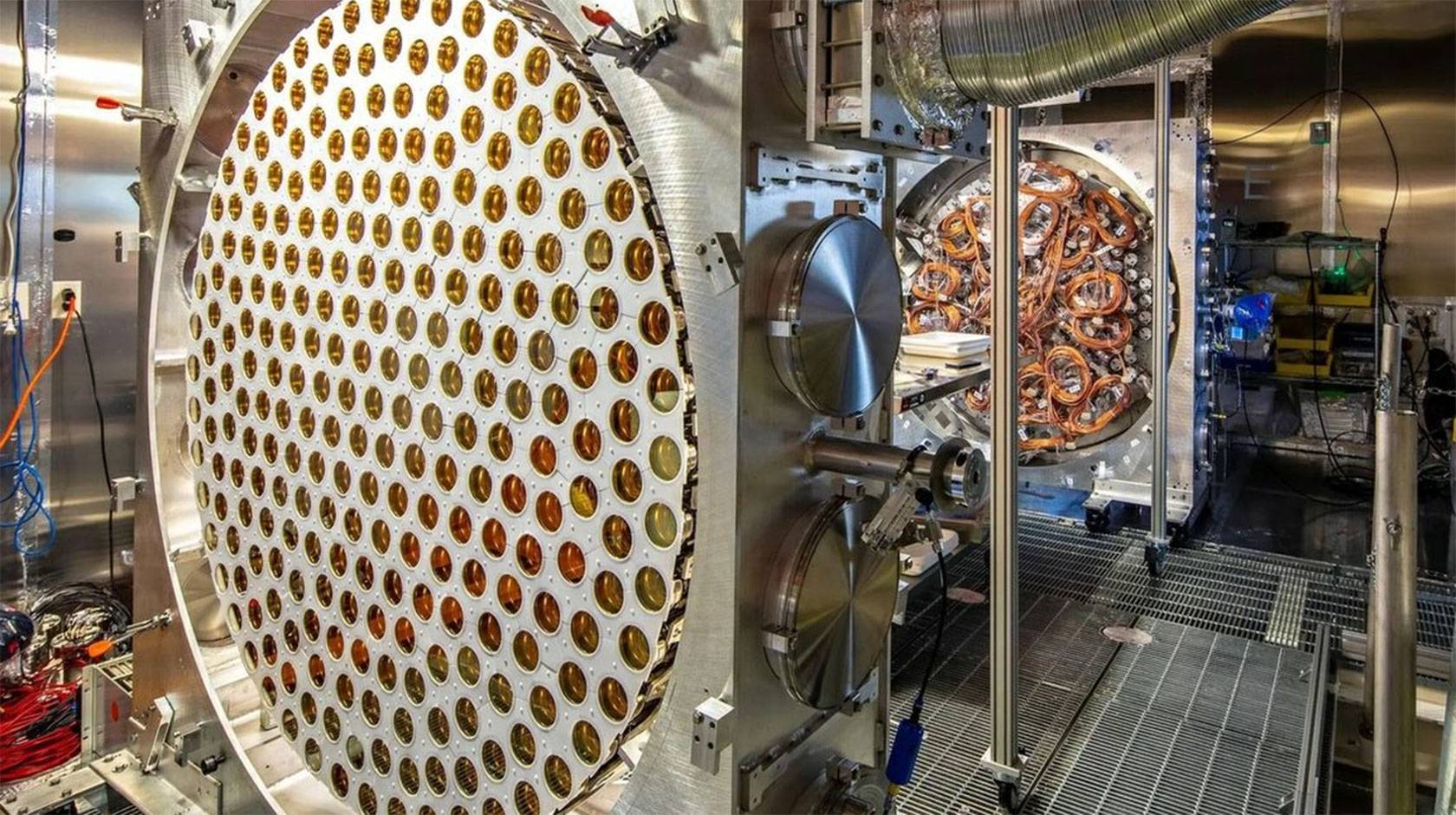
“This result is incredibly exciting and could represent the first hint of a dark-matter signal, though we can’t say that for certain yet,” said UCLA astrophysicist and co-author Alvine Kamaha, one of 250 scientists around the world who collaborate on an experiment called LUX-ZEPLIN (LZ), a sophisticated dark matter detector buried nearly a mile underground in South Dakota. UC-affiliated Lawrence Berkeley National Laboratory manages the detector, and scientists from UCLA, UC Berkeley, UC Santa Barbara, UC Davis and the UC-affiliated Lawrence Livermore National Laboratory are also involved in the experiment.
Co-founded by UC Santa Barbara physics professor Harry Nelson, LZ looks for signature flashes of light from energy deposited in the detector, which involves 10 tons of ultrapure liquid xenon. The experiment is primed to detect a phenomenon known as a WIMP, or weakly interacting massive particle. These hypothetical particles, if they exist, would be massive enough to interact with gravity. But no one knows for sure because they have never been observed. Many physicists think that WIMPs might actually be dark matter.
A painstaking analysis of 220 days’ worth of data from LZ registered a single anomalous particle interaction. The collaboration had previously searched this dataset for faint signals from the simplest kinds of WIMP interactions. The new analysis searched for a broader range of possible WIMP interactions that could deposit more energy in the detector.
More observation needed
If the anomalous event was caused by dark matter, the WIMP that generated it would likely have a mass of at least 200 gigaelectronvolts, or more than 200 times the mass of a proton. It would also suggest a specific type of interaction between WIMPs and ordinary matter beyond the simplest model. The LZ results have not reached “5-sigma” significance, the statistical threshold considered a discovery in physics. The new analysis is 2.6 sigma, meaning there is approximately a 0.5% chance that the event could be explained by known backgrounds.
With additional data, researchers can test whether the finding continues to grow in significance or fades away. LZ has already accumulated the world’s largest dark matter dataset and will continue to accrue WIMP search data, substantially improving their search statistics.
“Outlier events in the data are not unexpected, but they usually stand out as a background of some kind when you look at them deeper,” said Aaron Manalaysay, a physicist at Berkeley Lab and chair of LZ’s institutional board. “This is the first example in any experiment I’ve worked on of an outlier that appears valid in every way. Of course, we’re still twisting our brains trying to think if there’s a rare background mechanism we could’ve missed, but it’s thrilling to wonder if this could be the first hint of a dark-matter observation.”