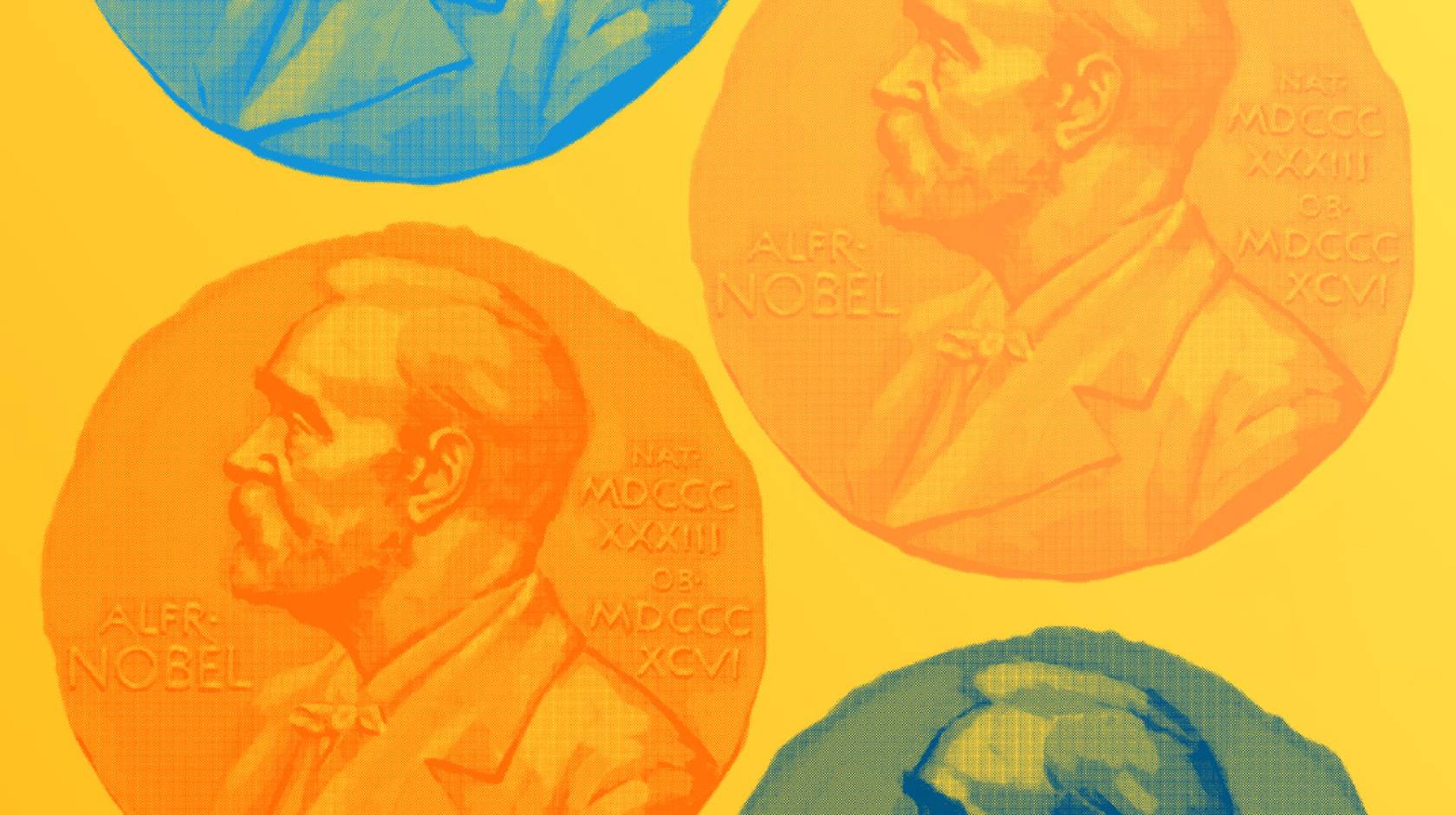
The Nobel Prizes recognize scientists, writers and activists whose achievements have changed the world. And as the institution with the faculty who've collected the most Nobels, UC has left the world much changed.
UC's Nobel Prize winners have revealed the shape of DNA, how plants transform sunlight and air into new growth, how and why our bodies age, and the black hole that lurks at the center of our galaxy.
You don't have to be a science geek to appreciate the benefits of UC's Nobel-winning research. These discoveries, many of which originated in federal funding, continue to shape daily life in surprising and amazing ways. Here are just a few innovations from UC’s world-leading Nobel legacy.
LED bulbs save Americans at least $14 billion a year
About 9 in 10 households in the U.S. have switched from incandescent lightbulbs to white LEDs that use less electricity and last much longer. The core of your everyday LED bulb is a blue light-emitting diode, invented by UC professor and 2014 Nobel laureate Shuji Nakamura.
Kidney donor matching helps people get transplants
Plenty of people would donate a kidney to a loved one who needed it. But most of the time they can’t, because the donor and recipient’s tissues don’t match. In 2004, economists figured out a solution: pooling willing donors and waiting recipients, raising the odds of a match. The algorithm behind these kidney exchanges originated with UC scholars David Gale and Lloyd Shapley, who initially applied it to romantic matchmaking. Before, pooled kidney exchanges led to fewer than 20 live transplants per year. Now such exchanges facilitate 1 in 5 of the 7,000 or so live kidney transplants in the U.S. each year — an impact that is part of what earned Shapley a Nobel Prize.
The Hepatitis B vaccine protects newborns from deadly liver disease
The Hepatitis B vaccine offers newborns long-lasting protection from a chronic and sometimes fatal infection. Virtually every dose of this vaccine given in the U.S. today comes from colonies of yeast modified to grow viral proteins. UC professor Randy Schekman's discovery of how yeast cells secrete proteins earned the Nobel Prize in 2013.
The ozone layer recovered from CFCs
Ozone gas in Earth’s atmosphere shields us from the sun’s UV rays, so spending five minutes outside doesn’t leave you with a bad sunburn. UC’s Sherwood Rowland, Mario Molina and Paul Crutzen shared a 1995 Nobel Prize for proving that common industrial chemicals such as chlorofluorocarbons (CFCs) destroy ozone. Their research led to a global ban on these chemicals, which has allowed a hole in the ozone layer to shrink, averting planetary catastrophe.
Cancer gene discovery improves prevention and treatment
Cancer tends to run in families, but it’s also caused by factors like smoking, sun and chemical exposure. UC’s J. Michael Bishop won the 1989 Nobel Prize for explaining why. In the 1970s, he discovered that some normal genes can mutate over the course of a lifetime to cause out-of-control growth. Realizing that cancer can arise from our own genes paved the way for better prevention strategies and lifesaving drugs, also from UC, like Herceptin for breast cancer and Gleevec for chronic myeloid leukemia.
Hormone therapies give people better options for reproductive health
Lots of bodily functions are guided by hormones released by your pituitary gland, a pea-sized clump of tissue inside your skull. UC’s Roger Guillemin shared a Nobel Prize in 1977 for discovering how your brain steers your pituitary gland. By mapping these signal pathways, Guillemin’s discovery led to hormone-based medicines to treat infertility, prostate cancer and endometriosis.
Lasers power everyday technology
The next time you’re in the checkout line at the grocery store, spare a thought for UC physicist Charles Townes. In 1953, Townes built the first maser, a device that amplified and emitted microwaves. This was a key step toward the invention of the laser, which works in a similar way, but uses visible light instead of microwaves. Townes won a Nobel in 1964, and now lasers are everywhere, from the fiber-optic cables that carry the internet to your home to operating rooms to the barcode scanners in your grocery checkout line.