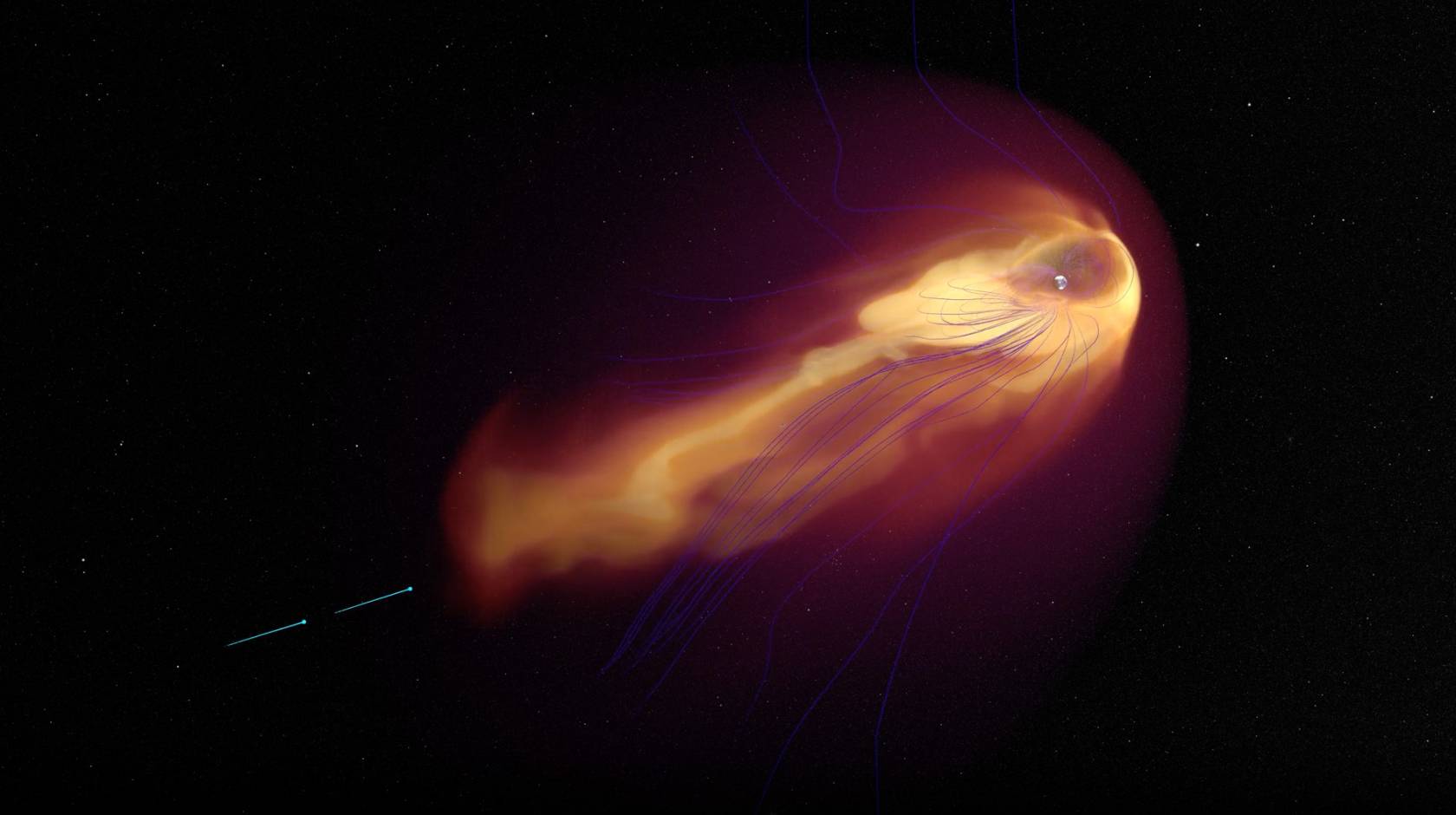
With their instruments now fired up and recording data, the twin ESCAPADE satellites are undertaking a test run before they head to Mars later this year. On Wednesday, Mar. 4, they will plow through a never-explored area around Earth: its distant magnetotail.
The 10-day excursion through our long magnetic wake, created as the solar wind sweeps past Earth, could yield new information about how distant magnetic fields affect space weather around our planet and the colorful auroras known as the Northern and Southern lights.
“This is a great opportunity for us to test the operation of the ESCAPADE instruments and explore a brand-new region of space — and hopefully make some discoveries,” said Rob Lillis, principal investigator for the mission and a researcher at UC Berkeley’s Space Sciences Laboratory. “We will be looking for what’s known as magnetic reconnection, when essentially oppositely directed magnetic fields combine and snap back, accelerating plasma in the direction of the earth, which is one of the processes that contributes to the aurora.”
Launched on Nov. 13, 2025, NASA’s ESCAPADE mission (short for Escape and Plasma Acceleration and Dynamics Explorers) is destined for Mars to investigate the solar wind’s impact on that planet. One key question is how the solar wind — fast particles ejected by the sun during intense magnetic activity — interacts with Mars’ magnetic environment and how this interaction drives the planet’s atmospheric escape.
But before heading to Mars, the satellites are taking one of two swings around Earth, the perfect opportunity to sample the part of our planet’s magnetic field that extends away from the sun more than a million miles (about 2 million kilometers). The two ESCAPADE spacecraft — Blue and Gold — are the first to travel through this distant part of the magnetotail.
In this video, Lillis explains the magnetotail fly-through using a visualization created by NASA’s Scientific Visualization Studio. The visualization uses a detailed simulation (by scientists at Kyoto University) based on data collected by other spacecraft in the inner part of Earth’s magnetotail, but since there are no measurements from the region ESCAPADE will fly through, the distant part of the magnetotail that ESCAPADE will traverse does not appear in the visualization.
After their encounter with the magnetotail, the ESCAPADE satellites will leave Earth, then swing one last time around our planet, in early November, before leaving forever on their trajectory toward Mars. They will arrive in Fall 2027.
Related information
NASA’s ESCAPADE ready to study space weather from Earth to Mars (Feb. 26, 2026)