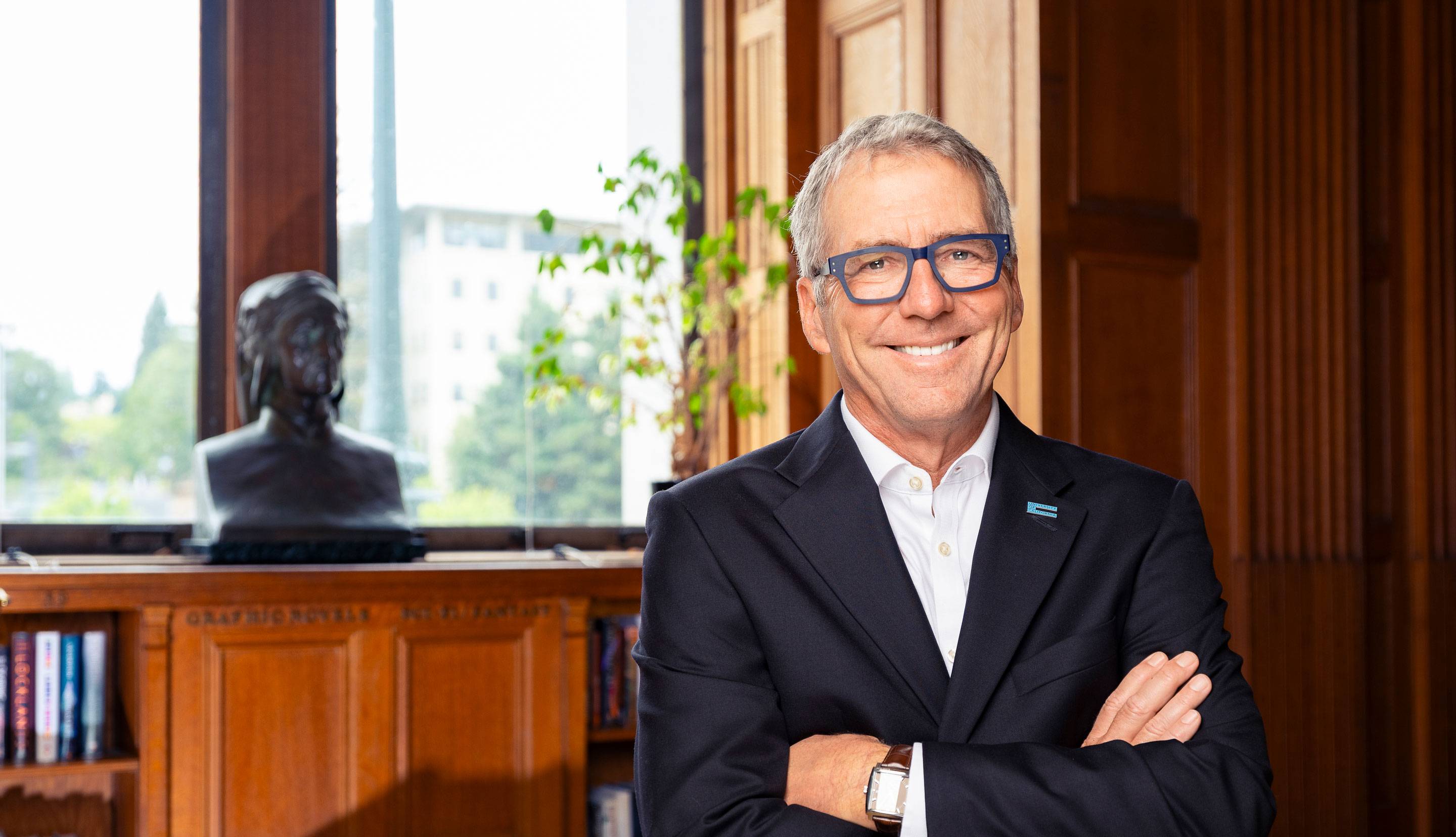
James B. Milliken
University of California’s 22nd president
Moving the University of California forward.
President Milliken is a distinguished higher education leader with more than 30 years of experience serving in leadership roles at large institutions. He brings a strong focus on research and academic excellence, a deep commitment to making college accessible and affordable, and experience leading a large academic health care system.
As president of the University of California, he oversees UC’s world-renowned system of 10 campuses, six academic health centers, three affiliated national laboratories, more than 300,000 students and 265,000 faculty and staff.
UC stands up for science by cosponsoring bipartisan Senate Bill 895
University research is under attack. Sen. Scott Wiener’s bill aims to protect and fund critical research benefitting millions of Californians now and in the future. The University of California is proud to cosponsor the bipartisan Senate Bill 895.
We will always stand up for science.
News and updates
President’s Leadership Conversation: UC Santa Cruz Chancellor Cynthia Larive
Los Angeles Times: ‘Harvard is fighting Trump. UC president says he wants to try ‘a better course’’
President James B. Milliken’s opening remarks to the California Assembly Subcommittee on Education Finance as delivered
The Gold and the Blue, Volume 22
Follow President Milliken on Substack, where he shares reflections on the state of higher education, UC’s enduring strengths, and other thoughts along the way.
Presidential engagement
To invite President Milliken to an event, please complete the Presidential Invitation Form in advance and a team member will contact you soon. If you have questions or would like to discuss your request, please reach out to president-invite@ucop.edu.
Contact
Please direct general inquiries for President Milliken to president@ucop.edu.
Media inquiries: media@ucop.edu
Invitations: president-invite@ucop.edu
Phone
(510) 987-9200
Mailing address
Office of the President, University of California
1111 Franklin Street, 12th Floor, Oakland, CA 94607
Please note that correspondence may be read or answered by members of the president’s staff or appropriate campus personnel. The President’s Office retains copies of all correspondence, and all correspondence is considered a matter of public record.